

As drone applications evolve from consumer-grade to industrial and critical infrastructure scenarios, transmission stability has become a core design parameter in system architecture.
Particularly in high electromagnetic interference (EMI) environments or long-range missions, the limitations of traditional wireless video transmission technologies are increasingly evident. As a result, the Fiber Optic Guided Drone (FOG-D) architecture is gaining industry attention.
FOG-D is not a single product, but rather a transmission architecture concept centered on a physical fiber optic link.
Its core principle is straightforward:
Replace wireless spectrum transmission with single-mode fiber as the medium for video and control signal delivery, thereby eliminating electromagnetic interference and spectrum suppression risks, and enhancing mission predictability.
Bottlenecks and Turning Points in Wireless Architectures
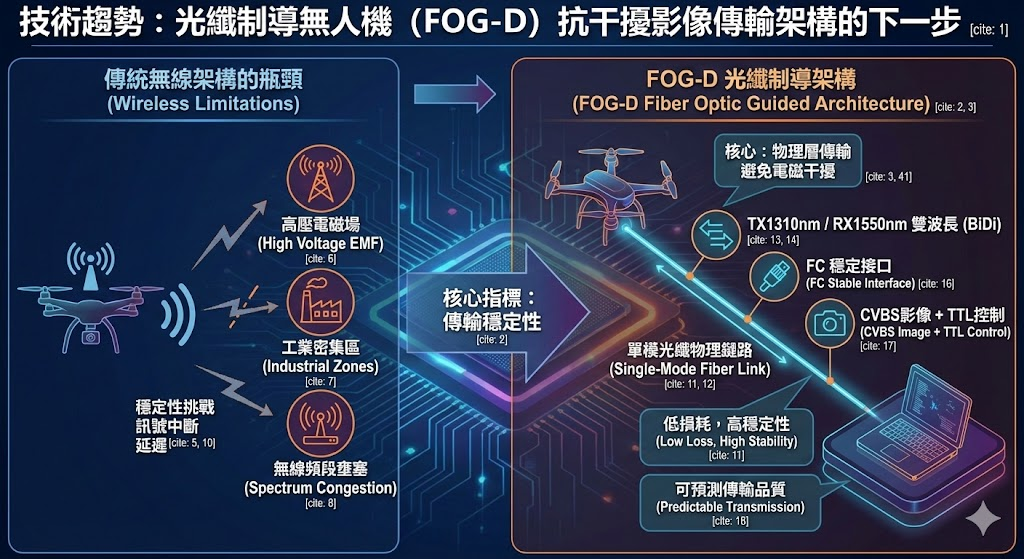
Wireless transmission offers rapid deployment and high mobility under normal operating conditions. However, its stability becomes challenged in the following scenarios:
- High-voltage electromagnetic field zones
- Industrial-dense environments
- Congested RF spectrum conditions
- Precision missions requiring highly stable control
When video latency or control signal interruption directly impacts decision-making outcomes, transmission architecture must be reconsidered at the physical layer level.
This is precisely why fiber optic guided drone architectures are becoming increasingly important.
The Role of Single-Mode Fiber in FOG-D Architecture
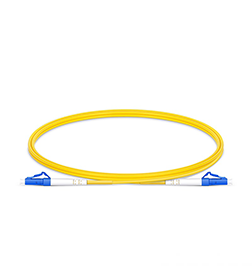
Single-mode fiber (SMF), characterized by low attenuation and high bandwidth capability, provides superior stability for long-distance links.
By transmitting optical signals through a single propagation mode, dispersion and interference risks are significantly reduced, maintaining signal integrity within controllable parameters.
In fiber optic guided drone applications, single-mode fiber is typically deployed with:
- TX1310nm / RX1550nm dual-wavelength architecture
- Single-fiber bidirectional (BiDi) transmission
- FC stable connector interface
- Synchronized CVBS video and TTL control signal transmission
This architecture does not aim to maximize extreme bandwidth.
Instead, it prioritizes stable and predictable transmission performance.
The Positioning of Optical Modules Within the Overall System
It must be clearly stated:
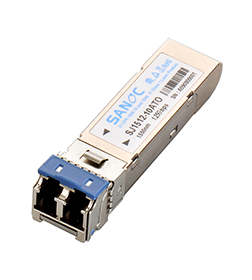
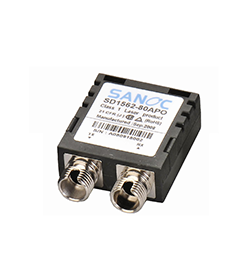
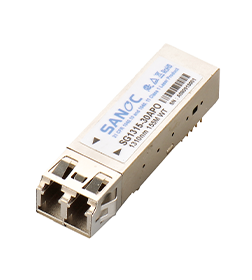
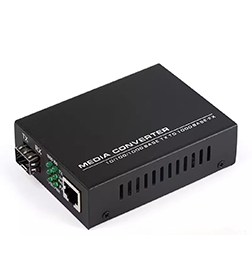
Fiber optic transmission modules are not a complete FOG-D system, but rather the core physical-layer component within it.
Their functions include:
- Establishing a stable video return link
- Synchronizing control signal transmission
- Delivering low power consumption and industrial-grade environmental durability
- Supporting long-distance transmission requirements (actual distance depends on fiber quality and system design)
Through modular design, system integrators can build fiber optic guided architectures tailored to specific mission requirements.
Why Supply Chain Compliance Matters
In government projects, international collaborations, or critical infrastructure applications, technical specifications alone are not sufficient.
Supply chain origin and compliance become equally critical evaluation factors.
This fiber optic transmission module features:
- Made in Taiwan manufacturing
- Non-PRC supply chain architecture
- TAA Compatible support
- ISO-certified manufacturing processes
This extends beyond product quality.
It directly impacts project compliance, procurement qualification, and long-term supply continuity.
Technology Trend Outlook
Fiber optic guided drones are not designed to replace wireless transmission.
Instead, they provide an alternative stable solution in high-interference or high-risk environments.
Their application potential is expected to continue growing in:
- Industrial inspection within high-EMI environments
- Long-distance infrastructure monitoring
- High-reliability video return missions
- Projects with specific compliance requirements
In transmission architecture design, the true core is not speed.
It is stability and predictability.
If you are evaluating fiber optic guided drone transmission architectures, single-mode fiber video return solutions, or require compliance with Non-PRC supply chain and TAA Compatible standards, we welcome further discussion with our technical team.
We welcome collaboration discussions regarding fiber-based transmission solutions and project-specific requirements.

